Built on top of the Swiss engine, with unique features not found in a generic Swiss for football or padel: scoring by skill levels, editable seeding, bye and withdrawals, globally optimal matchmaking, float distribution, and balanced colors.
McMahon
Swiss with an initial score based on seed band (kyu/dan range). Without seeds, it automatically becomes a pure Swiss system. It supports a "floor" (lower limit) so that beginners are not at an excessive disadvantage, and the McMahon bar itself, which increases by one point per round and determines which games at the top of the group are played at the same level (without handicap stones) and how far apart players are separated by club or country.
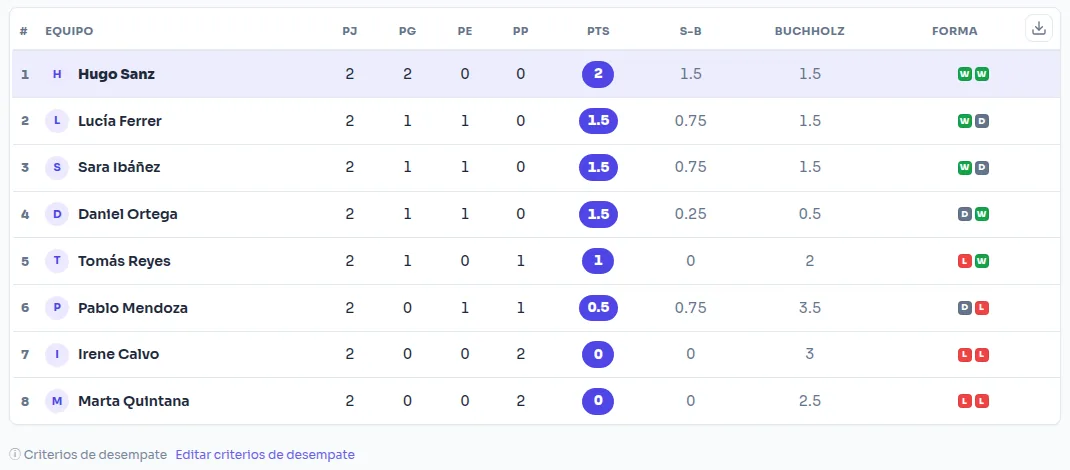
Editable seeding
The organizer can reorder the seeding using drag-and-drop instead of relying on the order of registration; this is available when the first phase is Swiss, McMahon, knockout or double elimination. In a Swiss, the seeding sets round 1 the FIDE way: the top half plays the bottom half (with 20 players, 1-11, 2-12…) and, with an odd number, the lowest seed gets the bye. You choose it in the Swiss phase options (“Round 1 pairing”): by seeding or random draw; chess and Go default to seeding. With seeding chosen but not reordered, registration order is used.
Automatic bye and mid-tournament withdrawal
The odd player out receives a bye, which is recorded as an actual win (it scores). A player may withdraw mid-tournament without losing their record; they are excluded from future rounds.
Global minimum-cost pairing
Each round is resolved in a single pass using a maximum-weight matching algorithm on a general graph (a variant of Galil/Edmonds), rather than by bracket. This prevents rematches and groupings by the same club or country through structural exclusion of edges, rather than solely by weight.
Float distribution
The pairing penalizes those who have "floated" the least (played above or below their level), distributing that burden equitably across the rounds.
Balanced color
A custom heuristic that assigns white and black while seeking to balance the number of games played with each color per player. It does not reuse the home/away concept, which continues to have a different meaning in team leagues that also use the Swiss engine.
Automatic stone handicap
Between two players with a recognized Go rank (5k, 1d…), the weaker player receives additional stones and plays Black — OpenGotha-style: stones = rank difference − 1, with a configurable cap (9 by default) and an optional even correction to adjust the standard calculation.
GoR rating (EGF)
Alongside the generic Elo rating, Go has its own rating calculated using the official formula of the European Go Federation, calibrated for the kyu/dan rank scale (2100 points ≈ 1 dan, +100 per rank), which is not directly comparable to the Elo used in other sports.
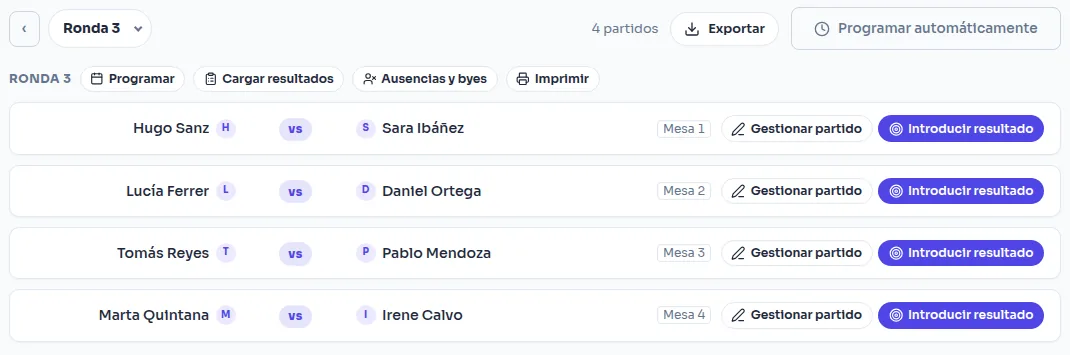
Table numbers
Every match in a round can have a table number assigned, shown both in the round view and in the pairings PDF — useful for players to find their seat at an in-person tournament without relying on word of mouth.
Team tournaments with board-based scoring
A team format in which each fixture is played across several simultaneous boards (real 1v1 games between players from each team), and the team result comes from how many boards each side wins. Each board applies its own Elo/GoR rating once it's finished, just like a standalone game.
See also
- Points and tiebreaks — FIDE and Go presets.
- Exports — EGD and TRF16.