The points awarded for a win, draw, and loss, as well as the tiebreak criteria, can be configured for each competition; they are not dictated by the chosen format.
Configurable points
pointsWin / pointsDraw / pointsLoss allow decimal values, which can be configured
on a per-competition basis. By default, they are applied based on the sport:
- Football and team sports with draws: 3 / 1 / 0
- Handball, basketball and American football: 2 / 1 / 0
- Volleyball: 3 / 0 / 0, with 2 / 1 for close results (see below)
- Chess: 1 / 0.5 / 0
- Racket sports (padel, tennis, pickleball, etc.): 1 / 0 / 0 (no draws)
- Rugby: 4 / 2 / 0
- Bowling: 0 / 0 / 0 plus points per game (see below)
- Darts: 2 / 1 / 0, with draws and leg difference as the tiebreak
- Billiards: 2 / 1 / 0, with draws and frame difference as the tiebreak
- TCG (Magic, Lorcana, One Piece…) and TCG Pokémon: 3 / 1 / 0, with draws
- Team chess: 2 / 1 / 0 per match; the score is board points (2½–1½), which break ties
- Team Go: 2 / 1 / 0 per match; board points and SOS break ties (as in the European Team Championship)
- Team padel, table tennis, badminton and tennis: 2 / 1 / 0 per tie; the score is matches won (3–2), and ties are broken by matches, sets and games (or points, in table tennis and badminton)
In 1-on-1 sports where there is always a winner (a fighting game, for example), draws can be disabled when creating or editing the competition: draw results are blocked, and a winner is required to save the score.
Close results (3-2-1-0 system)
Besides win, draw and loss, every competition (and every season) can set pointsWinClose and pointsLossClose: the points for a “close” win and a “close” loss. This is volleyball's 3-2-1-0 system: 3 points for winning 3-0 or 3-1, 2 for winning 3-2, 1 for losing 2-3 and 0 for losing 0-3 or 1-3. Both fields are optional: when empty, close results are disabled.
- Set-based sports (volleyball, padel, tennis...): a win by a single set (2-1, 3-2) is a close win. It is worked out from the set score itself.
- Every other sport (hockey, handball, futsal...): a match decided in extra time or on penalties is a close result. When saving the result, tick “Decided in extra time or on penalties”; the box only appears if the competition has close-result points configured.
- Defaults: volleyball starts with 3 / 0 / 0 and close results 2 / 1. In other sports they are off; in the scoring tab, the “Use 3-2-1-0” button fills in 3 / 0 and 2 / 1 in one click.
Matches decided in extra time or on penalties are tagged “ET” in the match list (close wins by sets carry no tag: the set score itself shows them). A draw still scores whatever you have configured.
Bonus points (rugby)
Each competition (and each season) can add rugby-style bonus points on top of the win, draw and loss points. There are two independent bonuses worth +1 point each; when empty, they are off.
- Try bonus: +1 to a team scoring N tries or more, whether it wins, loses or draws. With the “Tries more than the opponent” box ticked, the difference counts instead (N more tries than the opponent, as in the Top 14). Tries are entered in the match report; a match without them gives no try bonus.
- Losing bonus: +1 to a team losing by N points or fewer. It comes straight from the score.
- Defaults: rugby starts with 4 / 2 / 0, a try bonus for 4 tries and a losing bonus for 7 points or fewer (World Rugby rules). They are off in every other sport.
Walkovers and byes never give bonus points. If any team has a bonus, the standings show a “BP” column (already included in the points). If the score is corrected from a screen without the tries fields (bulk entry, captain report), the tries are cleared because they belonged to the previous result.
Points per game (bowling)
In bowling, each set in the score is one game with the pinfall for each side. Each competition (and each season) can award points per game on top of the win, draw and loss points. Both fields are optional; when empty, points per game are off.
- Points per game won: to whoever wins each game; a tied game gives half to each side.
- Points for the series: to whoever has the higher total pinfall across all games; a tie gives half to each side.
- Defaults: bowling starts with 0 / 0 / 0, 1 point per game won and 1 for the series (the 4-point system used by USBC leagues with 3-game series). In a walkover the winner gets the game points given by the walkover score plus the series points.
Configurable tiebreaks
For games with a clear win-or-loss outcome (chess, Go), there are two different presets, each in accordance with the convention of its federation:
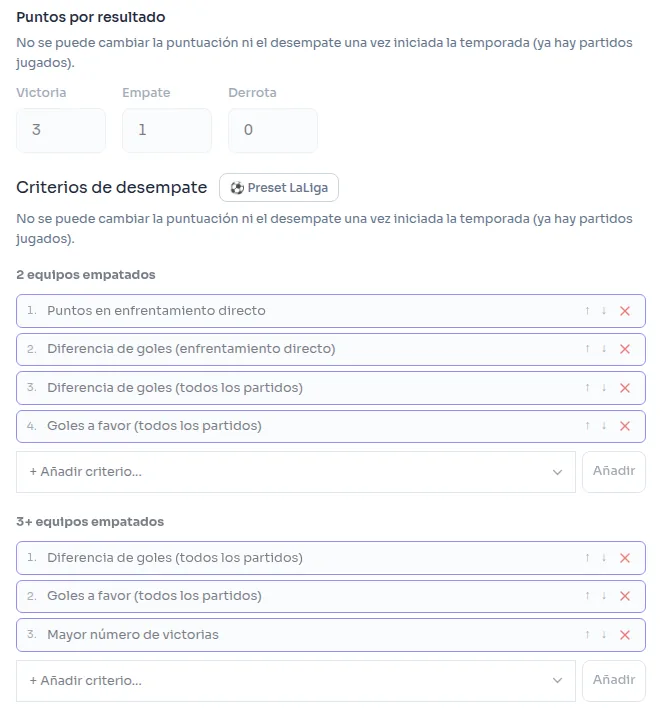
- FIDE preset (chess): head-to-head → Sonneborn-Berger → Buchholz → number of wins → alphabetical order.
- Go preset: Buchholz → SOS-of-SOS → number of wins, following the specifications of the European Go Federation and the British Go Association (deliberately different from the order used in chess).
See the details of the specific mechanics for these two games under Chess and Go.
In card games tiebreakers follow each game’s official rules. TCG (Magic, Lorcana, One Piece…) uses the Magic Tournament Rules (MTR): opponents’ match-win % (OMW%), game-win % (GW%) and opponents’ game-win % (OGW%), with a 33% floor and the bye counted as a 2-0 win. TCG Pokémon uses the Play! Pokémon rules: head-to-head when two are tied, opponents’ win % (OMW%) and opponents’ opponents’ win % (OOMW%), with a 25% floor.
Warhammer 40,000 starts with 3 / 1 / 0 and breaks ties by strength of schedule (opponents' win %), then victory points (VP) scored and VP difference, as in tournaments run on Best Coast Pairings.
Games won and fair play
In sports played by sets (padel, tennis, volleyball...), the difference between games won and lost is used as a tiebreak criterion. Fair play (card points) can also be added as a last tiebreak for team sports: when all other factors are equal, the least-sanctioned side wins.