A competition is a sequence of phases — each with its own pure pairing engine (round-robin, knockout, Swiss, double elimination or McMahon) — chained together through an advancement rule that determines who advances from one phase to the next.
Example
Regular league (phase 1, round-robin engine) → the top 8 in the standings play a playoff bracket (phase 2, knockout engine). Phase 1's advancement rule defines that cutoff of 8 qualifiers; phase 2 starts automatically with that seeding as soon as phase 1 ends.
Two ways to create the structure
- Simple mode — pick any of the 9 predefined formats with a single click.
- Advanced mode — a free visual phase builder, not limited to the predefined templates; it also allows double elimination.
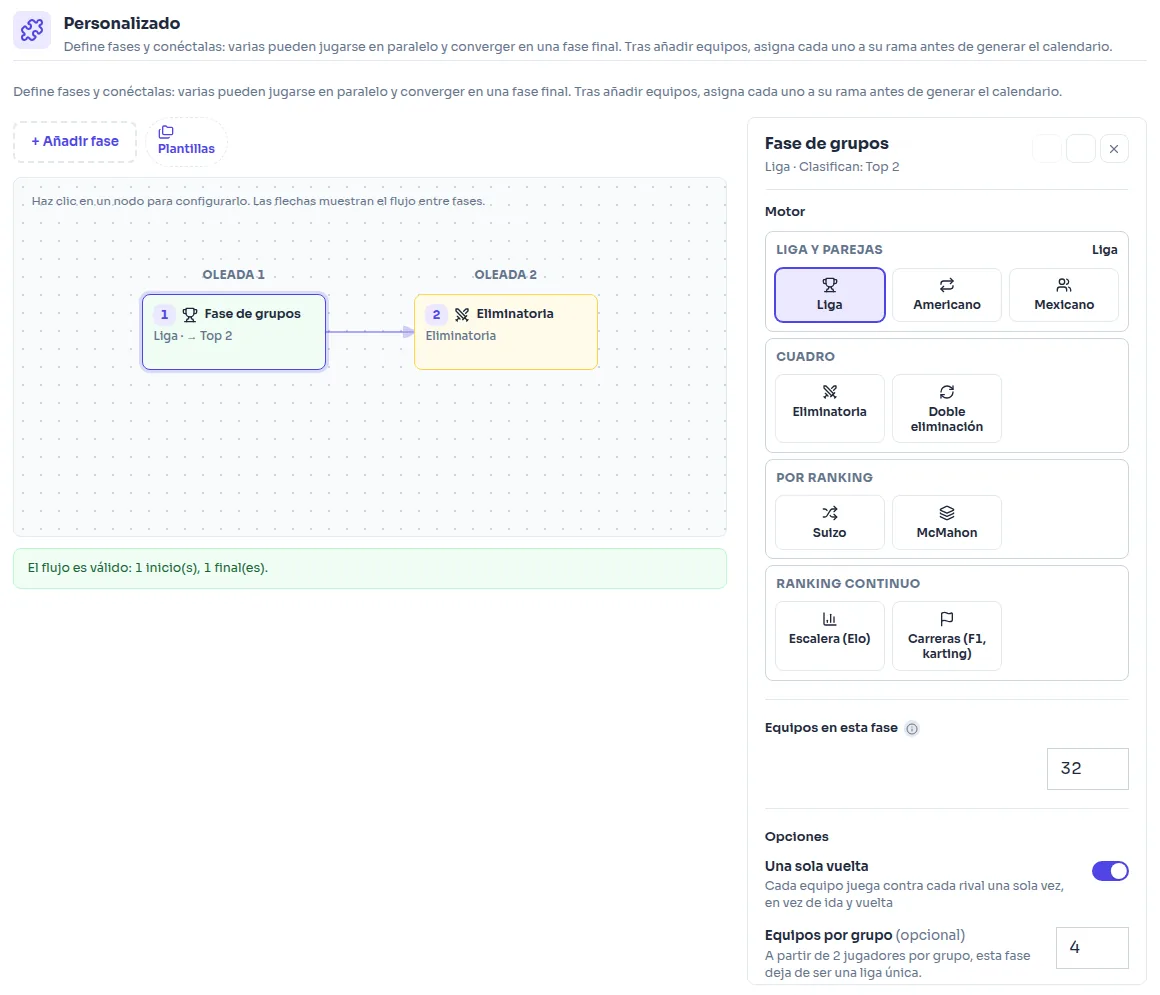
The phase structure can only be safely edited while the competition does not yet have a generated schedule; once matches are scheduled, changing the number or type of phases would no longer make sense, since the results are already recorded.
The standings tab
This is the visual hub for each phase: a standings table for league, Swiss, or McMahon, or a visual bracket with the champion highlighted for knockout and double elimination.
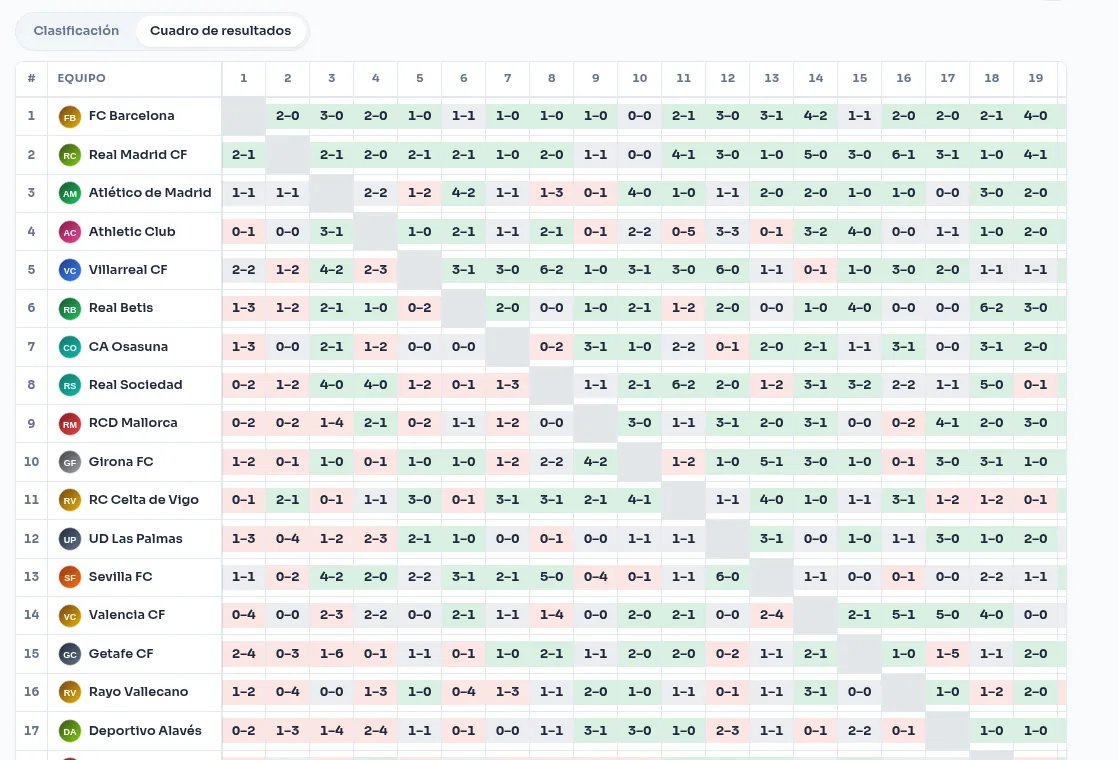
In leagues, next to the standings there is the results grid (cross table): every participant against every other in a grid. In home-and-away leagues the row is the home side and the column the away side; in single round-robin leagues, each result reads from the row's point of view. Tapping a result opens the match, and the grid can be exported to PDF. It is shown for groups of up to 20 participants; beyond that it stops being readable.
Categories within a single competition
When creating the competition, you can give it several category names (Junior and Senior, for example): each category gets its own independent phase structure — standings, schedule, and phase advancement kept separate — without having to create a different competition per category.
Consolation draw
A stage can have several outputs, each with its own advancement rule. That’s how you build a consolation draw: the top 2 of each group go to the main draw and places 3 and 4 to another draw played at the same time. In advanced mode there’s a “Groups + consolation” template and a “Places X to Y” rule (per group or in the overall standings); in the “Groups + Knockout” format you just turn on the “Consolation draw” switch. The same place can’t go to two outputs: the builder warns you and won’t let you continue until it’s fixed. Withdrawn participants don’t take a place, so nobody ends up in both draws or in neither.
Consolation for first-round losers
In a knockout draw, anyone who loses their first match can keep playing. In the “Knockout tournament” format just turn on the “Consolation draw for first-round losers” switch; in advanced mode there’s a “Draw + losers’ consolation” template and a “First-round losers (consolation)” rule for an output of the draw. The consolation draw starts as soon as the whole first round has been played, while the main draw carries on, and the champion and podium come from the main draw. Players with a first-round bye don’t enter it: with 6 entrants in a draw of 8 there are 2 byes and 4 play the first round, so 2 play the consolation; if only 1 would drop into it, the competition can’t be started. If you correct a first-round result, the consolation draw is rebuilt automatically as long as none of it has been played; after that, that result can no longer be changed.
Chaining two Swiss phases with carried-over scoring
When chaining two Swiss-engine phases, the "Minimum points" advancement rule lets anyone who reaches a given score advance, with no fixed number of qualifying spots — unlike "top N" or "winner only". Participants who make the cut don't start the second phase from scratch: they retain their score and the history of opponents already faced in the previous phase, so the first round of the second phase doesn't re-pair players who already faced each other. Designed for the official Pokémon TCG format at Regional+ events (Swiss qualifying phase → Swiss-based top cut at large events), but available for any competition chaining two Swiss phases.