In racquet sports and similar games—padel, tennis, volleyball—the score is not based on a single result, but on sets, and each match affects the player's rating.
Scoring by Sets
The result is recorded set by set, not as a single overall score, in accordance with the specific format of each sport.

Rating after each match
Each player has a rating that automatically updates based on the result of each match played, regardless of the competition's overall standings.
Match rules
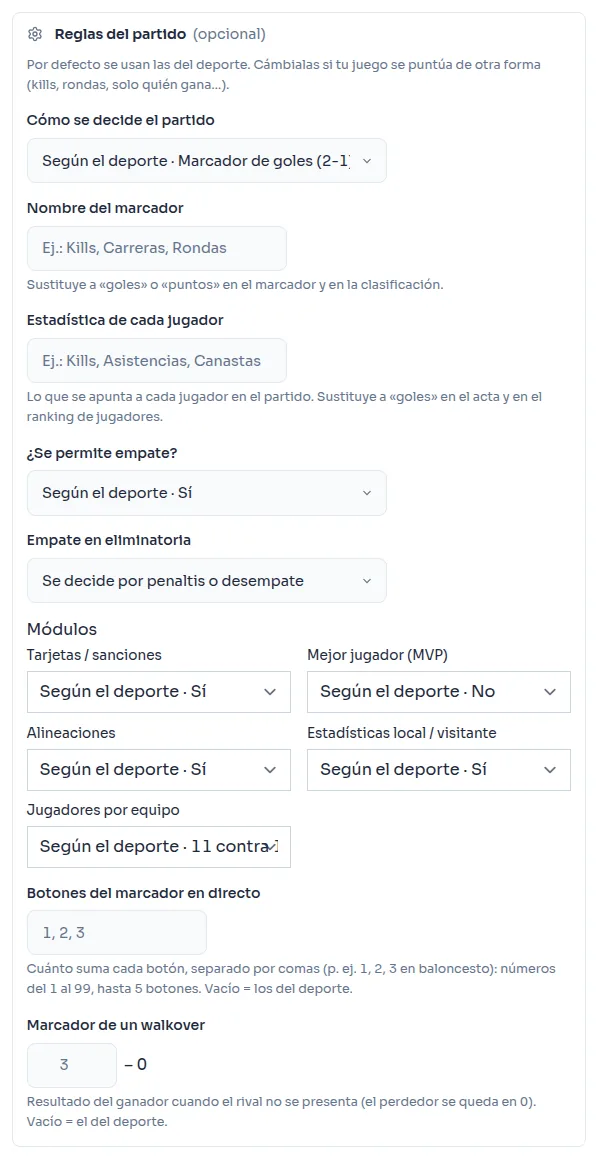
Every sport comes with its own default rules, but the organizer can change them when creating or editing the competition, in the "Match rules" section. That way it fits games that are scored differently (kills, rounds, runs…) or a house rulebook. Everything is optional: whatever you leave untouched uses the sport's defaults.
- How the match is decided: goal score (2-1), point score (87-80), set by set (6-4, 3-6, 7-5), maps or games best of X (2-1), or win/loss only.
- Score name: replaces "goals" or "points" on the scoreboard and in the standings (for example, "Kills" or "Rounds").
- Player stat: what gets credited to each player in a match. It replaces "goals" on the match report and in the player ranking (for example, "Baskets" or "Assists").
- Draws: whether a match can end in a draw or there is always a winner. Separately, a knockout draw can go to penalties or a tiebreak, or be played until someone wins.
- Walkover score: the result given to the winner when the opponent doesn't show up.
- Modules: turn cards and suspensions, match MVP, lineups and home/away stats on or off, so your sport only shows what it uses.
- Live score buttons: how much each button adds (for example, 1, 2 and 3 in basketball).
How the match is decided can't be changed once the schedule has been generated, because it would change the meaning of results already saved.
Best of X
With set or map scoring you can set a "best of" (1, 3, 5 or 7). The result has to fit: in a Bo3 only 2-0 or 2-1 are valid, and a 1-0 is rejected. Knockout rounds can be played to a different number than the rest (for example, Bo1 in the group stage and Bo3 in the playoffs). Once knockout matches exist, that setting is locked.
Team ties
In team padel, table tennis, badminton and tennis, each tie between two clubs is several singles and doubles matches, each scored set by set. A match is won by whoever wins more sets and the tie by whoever wins more matches; it closes once all are played or as soon as one team has the majority (3–0 out of 5). In “Match rules” you pick the system: 3 pairs in padel; Corbillon (2 players, 5 matches) or Swaythling (3 players, 9 singles) in table tennis; Thomas/Uber Cup (3 players, 5 matches) in badminton; Davis Cup with 3 or 5 matches in tennis; or “Custom”, with how many singles and doubles are played. In systems with a line-up (A, B, C against X, Y, Z, or pairs) the pairings fill themselves in; in “Custom” you choose them in each tie. Each match is entered and scheduled on its own (date and time, venue and court or table) from the tie’s edit screen, and the tie score updates as you go. With result confirmation turned on, each team’s captain enters their match from the match page and the other team confirms or disputes it.
Points per game
In table tennis, badminton and pickleball (and their team ties) you can choose in “Match rules” how many points each game is played to: 5, 7, 11, 15, 21 or 25. If you do, every game is checked when the result is saved: the winner must reach it with a 2-point lead (to 11: 11-9, 12-10…; in badminton to 21, at most 30-29), and an unfinished game or one without that lead is rejected. By default it isn’t checked, because many leagues play shorter games.